
Dr. Kim Thompson
2/24/2026
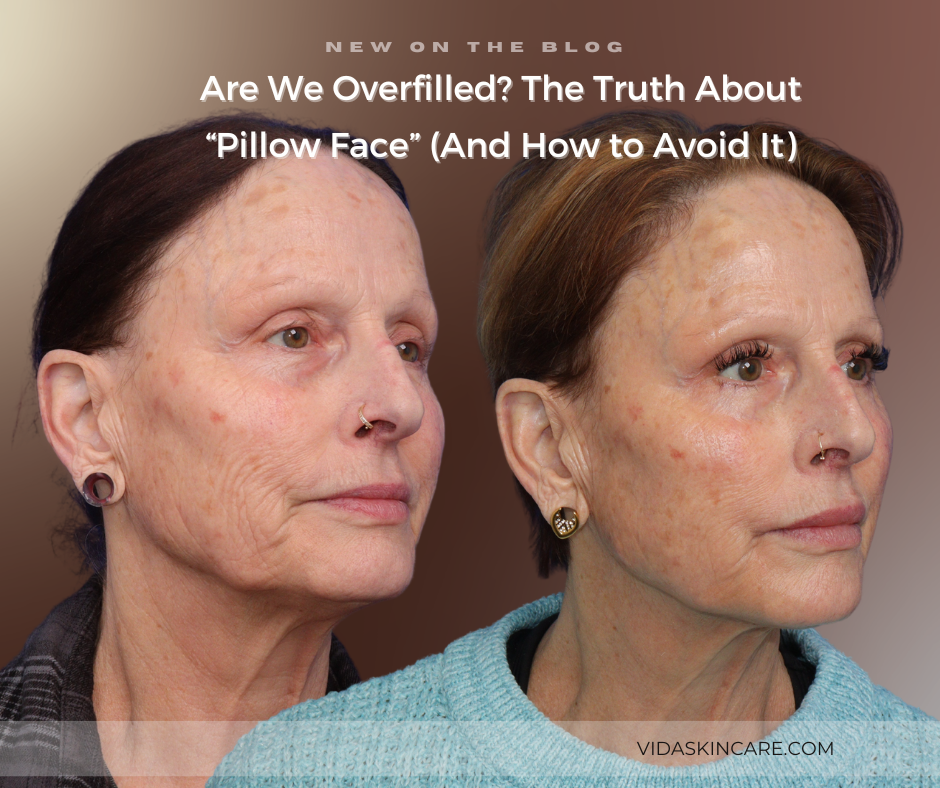
“Pillow face” is the look people fear most when they consider dermal filler: cheeks that seem too full, features that lose definition, and a face that reads “puffy” instead of refreshed. It’s also one of the most misunderstood outcomes in aesthetics, because in many cases, it’s not just about “too much filler,” but where, how, how often, and what the face actually needed in the first place.
This post breaks down what pillow face is, why it happens, what’s myth vs reality, and what a safer, more natural plan looks like, backed by peer-reviewed literature.
What “Pillow Face” Actually Means
Clinically, the overfilled look is often described as facial overfilled syndrome or overfilled face syndrome, an iatrogenic (treatment-related) aesthetic distortion that can show up as heavy cheeks, smoothed or “stiff” facial transitions, widened midface, and loss of natural contour. It’s been discussed in dermatology and cosmetic literature as a recognizable pattern that can include “pillow face” among other hallmark shapes.
Importantly: pillow face isn’t a moral failing or a “bad patient choice.” It’s usually the result of a plan that didn’t respect facial anatomy, aging patterns, or long-term maintenance.
Why Pillow Face Happens (It’s Usually More Than One Thing)
1) Treating every “dip” with filler instead of treating the cause
Faces don’t age because one area suddenly needs volume. Aging involves bone remodeling, ligament laxity, fat pad shift, skin quality changes, and muscle dynamics. When we chase every hollow with filler alone, volume can stack in ways that blur the natural architecture of the face, especially in the midface. This “volume-chasing” mechanism is a commonly cited driver of overfilled appearance.
2) Too much, too often, in the same zones
Repeated top-ups in the cheeks, tear trough, and nasolabial region can “build” a look over time, especially if each session adds volume without reassessing overall balance.
3) Product and placement mismatch
Different hyaluronic acid (HA) fillers behave differently (lift, spread, integrate, swell). If product choice or injection plane is off, it can create excess projection or a puffy transition between facial subunits.
4) Swelling, inflammation, or delayed reactions that mimic overfilling
Sometimes what looks like overfilling is actually persistent edema or a delayed inflammatory reaction, which can occur weeks to months after HA filler and may be triggered by immune activation (illness, vaccination, etc.). Management strategies in the literature commonly include corticosteroids and/or hyaluronidase depending on severity and presentation.
5) Filler movement/displacement (“migration”) or unexpected spread
Migration is real, and increasingly documented. Reviews describe cases where filler is found beyond the original injection site, with imaging (ultrasound/MRI) sometimes revealing more filler presence than what is clinically obvious.
Signs You Might Be Heading Toward “Overfilled”
These are common early clues (and good reasons to pause and reassess instead of adding more):
- Your cheeks look rounder but not more lifted
- You’ve lost definition at the cheek-to-lid or cheek-to-mouth transition
- Your side profile looks “projected” rather than sculpted
- Photos look puffier than the mirror (especially in flash)
- You’re doing frequent top-ups but satisfaction is going down
Can Pillow Face Be Fixed?
Often, yes—but the best approach depends on what’s causing it.
If it’s truly excess HA filler: dissolving may help
Hyaluronidase is widely used to reverse or reduce HA filler and to treat many HA-filler complications. A major clinical review covers its role, dosing considerations, and use across complication types (from aesthetic correction to urgent issues).
Important nuance: dissolving is not “erase everything instantly.” It can be staged and strategic, and it requires an injector who understands facial anatomy, risk management, and how to rebuild balance if needed.
If it’s swelling/inflammation: treating the reaction matters more than “removing volume”
Delayed inflammatory responses can require a different plan (and sometimes a medical workup). The literature describes a range of treatments depending on the pattern, including observation for mild cases and medications ± hyaluronidase for more significant reactions.
If it’s an aging-pattern mismatch: you may need lifting, tightening, or skin-quality work
Sometimes the fix isn’t “less filler”, it’s better structure and better skin:
- collagen stimulation (biostimulators where appropriate)
- energy-based tightening
- resurfacing for texture/pigment
- lower-face balancing (chin/jaw support rather than “more cheek”)
How to Avoid Pillow Face (The “Natural Results” Blueprint)
1) Treat the face in units, not in isolated lines
Good outcomes come from restoring harmony: cheeks, under-eye, temples, chin, jawline, and skin quality working together, not just filling the most obvious hollow.
2) Think “structure first, surface second”
When structure is supported appropriately, you often need less product overall.
3) Build a long-term plan, not a series of impulsive top-ups
Overfilled syndrome is frequently described as a cumulative issue, more likely when treatments are repeated without a reassessment of the full face and aging trajectory.
4) Use imaging when appropriate (especially for complex history)
Ultrasound is increasingly discussed in the field for identifying filler location and displacement, and for improving precision in certain contexts.
5) Choose a provider who will say “not today”
One of the biggest predictors of natural results is a clinician willing to pause, reassess, and sometimes recommend doing less.
The Bottom Line
“Pillow face” isn’t inevitable, and it isn’t the natural end point of filler. It’s usually the result of too much volume in the wrong places over time, sometimes compounded by swelling/inflammation or displacement. The safest path to natural results is an anatomy-based plan focused on balance, proportion, and long-term maintenance, not just adding more.
Natural, not noticeable.
If you’re worried about looking “overdone,” you’re not alone, and you have options. At VIDA, we prioritize facial balance, anatomy-first technique, and long-term planning so you look like you, just refreshed.
Book a consultation to review your facial goals, your filler history, and the most natural path forward. Whether that’s subtle refinement, correction, or a completely different approach.
References:
1) Lim TS, et al. “Exploring facial overfilled syndrome from the perspective of facial anatomy and aging.” Journal of Cosmetic Dermatology (2024).
https://pubmed.ncbi.nlm.nih.gov/38369859/
2) Lim TS, et al. (Full text landing page) Journal of Cosmetic Dermatology (2024).
https://onlinelibrary.wiley.com/doi/10.1111/jocd.16244
3) Peng CX, et al. “A Review: Causes, Consequences, and Management …” (2025) – discusses “overfilled face / pillow face.”
https://pmc.ncbi.nlm.nih.gov/articles/PMC12333868/
4) Kapoor KM. “Overfilled Face Syndrome: A Narrative Review …” (2025).
https://journals.sagepub.com/doi/10.1177/30499240251387458
5) Kroumpouzos G, et al. “Hyaluronidase for Dermal Filler Complications.” (2024).
https://pmc.ncbi.nlm.nih.gov/articles/PMC10836581/
6) PubMed record: Kroumpouzos G, et al. “Hyaluronidase for Dermal Filler Complications.” (2024).
https://pubmed.ncbi.nlm.nih.gov/38231537/
7) Wollina U. “Filler Migration after Facial Injection—A Narrative Review.” Cosmetics (MDPI) (2023).
https://www.mdpi.com/2079-9284/10/4/115
8) Schelke L, et al. “Post-Treatment Displacement of Facial Soft Tissue Fillers—A …” (Ultrasound study) (2024).
https://pubmed.ncbi.nlm.nih.gov/38833408/
9) Bhatia L, et al. “Systematic Review of Post-Viral Delayed Inflammatory Reactions after Hyaluronic Acid Dermal Fillers.” (2025).
https://pmc.ncbi.nlm.nih.gov/articles/PMC12565858/
10) Akyol ME, et al. “Understanding delayed-onset inflammatory responses …” (2026).
https://www.tandfonline.com/doi/full/10.1080/14764172.2026.2617549